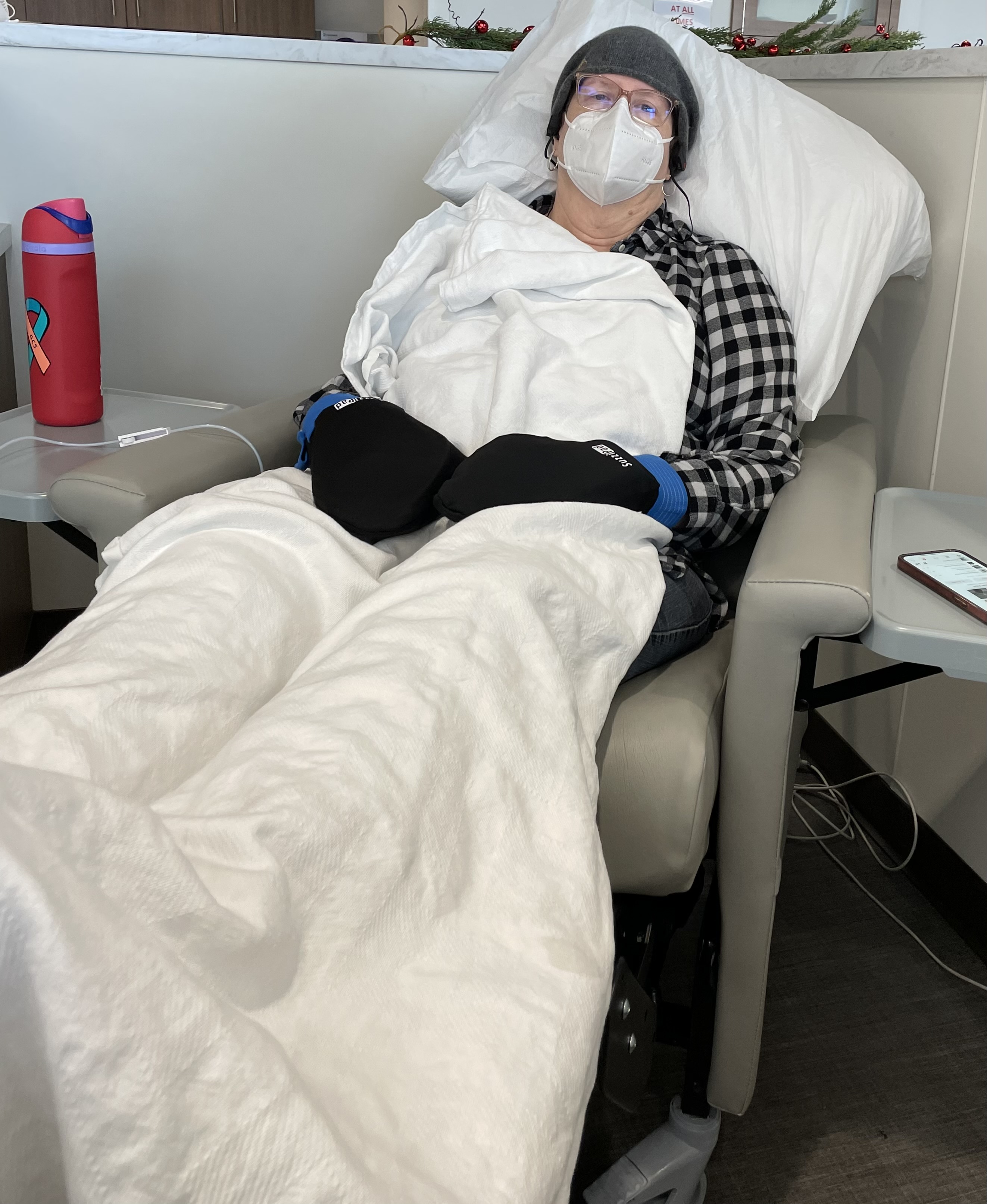
Sometimes anniversary dates creep up on you. Usually for me, there is a nagging sensation that something is not right. A vague uneasiness sits in the back of my mind… until I remember…
I realized that three years ago this week, I had my biopsy and the results came by phone from my gynecologist. I was down with COVID, feeling pretty rotten, so I couldn’t go into her office. “I am so sorry,” she said. “This is about the worst diagnosis you could get.” I wrote in my journal, “What the actual hell??? Ken has cancer. Now I have cancer. Lord, could we PLEASE catch a break??”
Tearfully, I began to share my news, first with my family, then friends and my church, and then talked with Ken’s oncologist (who became my doctor, too.) I was surrounded by love and reassurance, and slowly, we made a plan. Surgery, chemo, radiation, lab tests, scans… Meals, prayers, playlists, prayer shawls, hugs… This all happened in the midst of COVID. We were still wearing masks and all of the necessary PPE at work, still masking at church.
My life made a seismic shift three years ago. At times, the reality of what my body, mind and spirt went through still gives me pause. Even as I slowly regain mobility and strength, energy and resilience, the memories of the infusion room can come back in a heartbeat. And that’s true for all cancer survivors. We learn to compartmentalize our feelings in order to cope. It is far too easy to remember the brunt of the side effects, the bone pain, the hair loss, the “metal mouth”, and the memories of feeling absolutely awful, all for a chance to live.
In his signature work, Bessel A. van der Kolk wrote about the new way of living within one’s body and memories that has to happen after a life-changing event. The Body Keeps The Score: Brain, Mind, and Body in the Healing of Trauma explains the “brain reorganization” that happens as an individual recovers from a life-changing, and at times traumatic, event.
Remembering these experiences is not easy. It’s terrifying, in fact. One learns to lean on experience and pure grit. It takes guts to face the memories so full of emotional potholes, but with faith and hope and courage, we press on.
“It takes enormous trust and courage to allow yourself to remember.”
I choose to remember. I choose to honor what I experienced and coped with during treatment. I choose to continue to express my gratefulness to everyone who supported and prayed and loved me through it. I choose to honor God’s care for me in the midst of the tears and pain. Thanks be to God I don’t travel this alone.
From Psalm 103:
13 Like a parent feels compassion for their children—
that’s how the Lord feels compassion for those who honor him.
14 Because God knows how we’re made,
God remembers we’re just dust. (CEB)
 An Unfinished Symphony