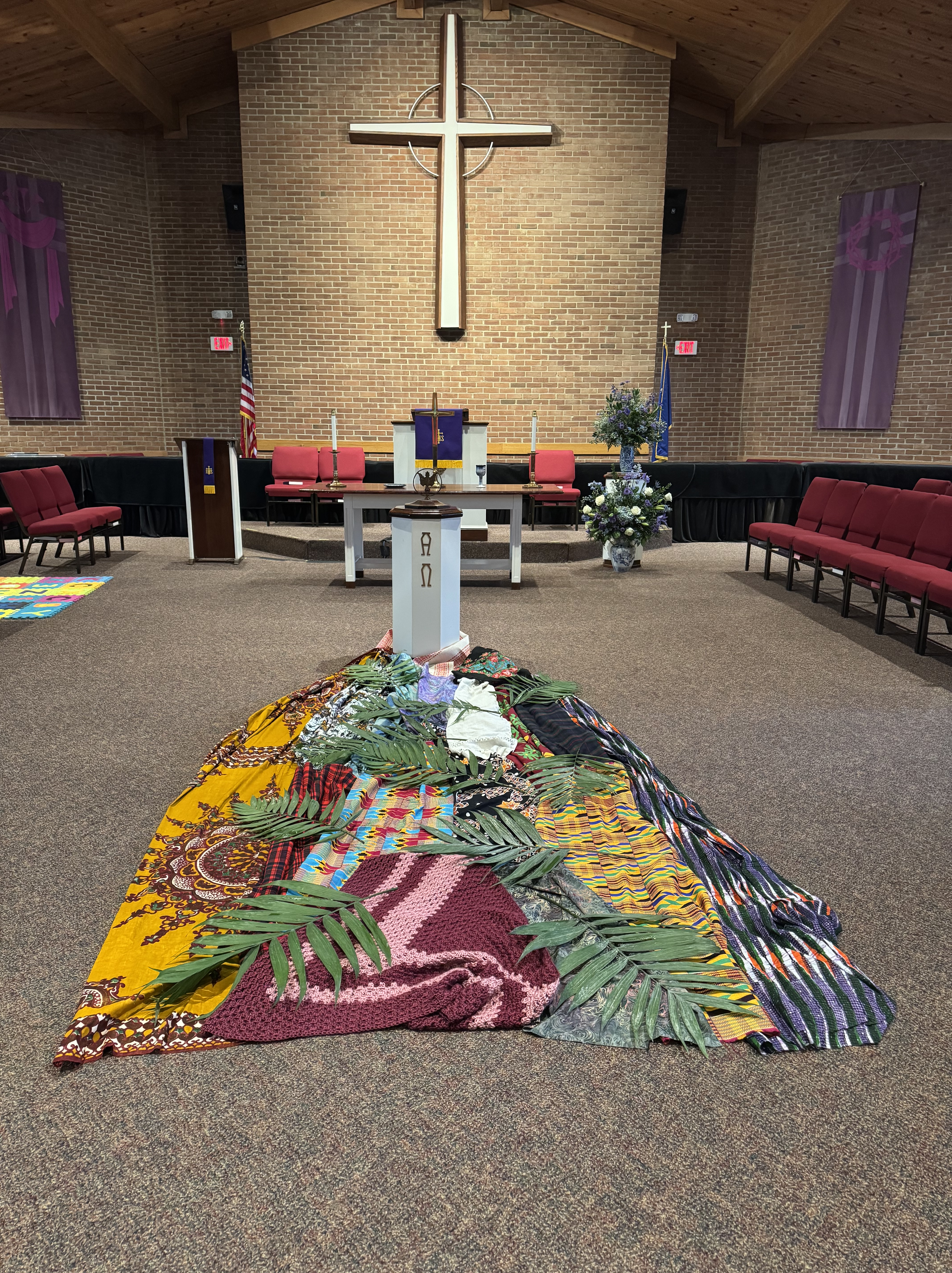
This “pathway” was created from fabric and fiber art created by members of the congregation. There were even more pieces added during the morning services. Our church is multi-national and multi-cultural, but together we worship one God.
I always hesitate to post my sermons. It’s not like I’m the best preacher or writer. But this Palm Sunday was not a week to be silent. Apologies that I was delayed from posting it, but… well, things are a little busy during Holy Week! I think there is merit in pondering it today on this Holy Saturday.
A Sermon for the People of God
at Gaithersburg Presbyterian Church
April 13, 2025 Luke 19:29-40 Palm Sunday
SHOUTING STONES
Every year as Palm Sunday and Easter roll around, I try to approach the lectionary verses with a fresh eye and an open heart. These scriptures are so familiar to us that even we pastors can go on auto-pilot. And so can our listeners… Hosanna! Shouts of praise! Palm branches! Cloaks and Donkeys!! We can get lost in the praise party, and forget the purpose of Jesus’ entry into Jerusalem.
We know the end of the story, after all. Easter’s coming! But let’s not get to Easter morning too soon…
As I studied this passage, I kept coming back to v 40:
I tell you, if these [the disciples] were silent, the stones would shout out.
The metaphor of shouting stones stuck with me… Shouting Stones!? What would that be like?
In the First Century BCE, there was a lot of “shouting” going on. The Jewish people were under occupation by the Roman Empire.
… An occupation with martial law.
….That put limits on religious activities.
….That confiscated land to build large homes for the rich and powerful at the expense of peasant farmers and laborers.
…That conscripted citizens to do menial chores with aggressive expectations of immediate subservience.
We forget that Jesus was living under this oppressive regime throughout his ministry! It impacted everything he said, every place that he taught, every person who questioned his boldness, his broadening welcome and acceptance of people who had been outcasts. Jesus was a Jewish man living under the Roman occupation. He did not ignore this! When teaching his disciples about becoming servant leaders, Jesus used an example of Roman law in Matthew 5. You might remember… he told his them that if they were told to carry a soldier’s pack one mile as allowed by Roman law, that they should carry it two miles. I wonder how well they handled that. It might have chafed a little!
The Jewish people were ripe for a leader, for someone to stand up and lead a rebellion. They wanted God’s promised Messiah to come to defeat their captors, establish justice and peace, and recapture their land. They were longing for freedom, and for Jesus to be their Deliverer. They knew this would happen someday – they had heard the Hebrew Scriptures. they remembered the passage from the prophet Zechariah:
Rejoice greatly, O daughter of Zion! Shout aloud, O daughter of Jerusalem! See, your king comes to you; triumphant and victorious is he, humble and riding on a donkey, on a colt, the foal of a donkey. (Zechariah 9:9)
The disciples were certain that Jesus was the one to be that triumphant and victorious king! But that was not on the agenda for that first Palm Sunday.
Throughout his ministry, Jesus was consistently focused on God’s purpose for his life. He “set his face towards Jerusalem” (Luke 9:51), steadfastly, consistently, purposefully. It did not make sense to his followers! They were in full rebellion mode. Despite seeing the past examples of the Romans squashing other rebellions, they were focused on their own agendas. I can imagine them saying: Let’s get some change up in here! FINALLY! Jesus! Let’s DO this! But Jesus told his disciples, multiple times, that he was going to Jerusalem to be betrayed and die, AND be raised from the dead on the 3rd day… They had no context to understand Jesus, or they had selective amnesia. They were stuck in a mindset of what they believed God was going to do. Fix things!! O Lord, we are patient… so do something NOW!
I don’t think we are that different… we have our own ideas about how God might work in the world today. If we’re honest, there’s a lot of shouting and not a lot of listening. The divisions are stark.
The conflict on the first Palm Sunday was between a servant leader, riding on a donkey, hearing shouts of joy and praise to God. And a power-hungry dictator, Pontius Pilate, on a war horse expecting subservience.
It was the Kingdom of God vs the Roman Empire.
A call to service and worship vs a show of dominance and oppression.
The Son of Man and Caesar who said he was the Son of a god.
Two cultures. Two philosophies. Two religions. And on that first Palm Sunday, there were two parades into Jerusalem.
We know the story of Jesus’ entry into Jerusalem as one parade as we heard this morning in our scripture reading.
Pontius Pilate led the other from the opposite side of the city, riding on a war horse, a symbol of dominance. There were rank upon rank of soldiers and weapons and armor. Historians such as Flavius Josephus, a 1st century Jewish priest, scholar and historian, writes about the Roman parades that were strategically designed as displays of power. The swords, the clanking of armor, the spears and shields glistening in the sun, the tramping of feet and hooves. And at times like Passover, when thousands of pilgrims were pouring into Jerusalem, the Roman procession was a show of force to remind them that the Romans were in charge. Priest or peasant, they were expected to comply.
In their book, The Last Week, A Day-by-Day account of Jesus’ Final Week in Jerusalem, authors Marcus Borg and John Crossman talk about how Caiaphas, the high priest, and other authorities were complicit in Roman rule and the suffering of God’s people. They write:
The high priest and Temple authorities had a difficult task. …Their primary obligation to Rome was loyalty and collaboration. They were to make sure that the annual tribute to Rome was paid. They were to maintain peace and order.
They also noted: The wealthy and powerful justify their position by saying, “This is the way it is”…
In other words… the priests and pharisees are telling the people — “just do as they ask so that they don’t treat us worse than they do now.” But their complacency, their silence made them part of the atrocities committed by the Romans. Today, friends, my place of privilege, having this white face, means that I could skulk under the radar, be a listener. But I cannot follow Jesus and remain silent.
Remember that when Jesus entered Jerusalem he came as God’s servant, riding a peasant’s beast of burden. A colt who was not broken, and had never been ridden. Another miracle? Perhaps. (Seriously: Have you ever rode a horse who is not fully trained? Or a donkey? Donkeys are the most stubborn creatures, with spines like rocks! The fact that this colt did not bolt or buck is a miracle! And if you know anything about horses, they are NOT fond of loud noises and shouting, and a press of people. I think donkeys would rebel, too.)
In this procession, the people followed Jesus into the city. They sang songs of praise, the Psalms which are labeled “A Song of Ascents” in our Bibles today. Borg and Crossman remind us:
Jesus was a Jewish voice, one of several first-century Jewish voices that stated what loyalty to the God of Judaism meant. And for Christians, he is the decisive Jewish voice.
The words of Christ are our authority. Not the government. Not the powerful. Not the rich. These themes of Empire domination and the Kingdom of God poke at us to respond. They remind us that Palm Sunday leads us to the cross… and the empty tomb. It’s hard, but we need to sit with this uncomfortable feeling of life’s challenges in our country and our world.
- Do we listen to voices of power and authoritarianism in our world? Where are we aligning ourselves? Which parade are we joining?
- Are we playing it safe so that we get along and protect what we have, OR are we standing up against injustice and prejudice and those who would strip the rights of our fellow citizens, and, in some cases, our rights as well?
- How do we live as law-abiding citizens, and God’s people? Where’s the line? What is too far?
- How do we, as a church of many cultures, many backgrounds, many experiences, face the divisions in our country today? As our pathway of cloth represents, we want to walk together, in God’s love, serving the people God brings in our path.
- Are we silent? Are we making excuses? Or are we responding with integrity and love, to pursue God’s way?
Friends in Christ, WE are the stones that must cry out. We are the ones who are here, watching and observing these two parades today. As we go through this week, where the story of betrayal and the crucifixion of Jesus is center stage in our observances and spiritual reflection… how will you respond? How will our congregation? Will we follow the parade of oppression or the one of hope and light and love?
The impact of the ministry and life of Jesus goes beyond buildings and pathways and rock outcroppings. It is through God’s people. WE are the Shouting Stones. We are like ripples in a pond, touchpoints of God’s work in the world. I can think of several people who have changed the world through art, through radical hospitality, through service. Their legacy shouts…
What will you lay down on this pathway… symbolically… as you lay down your palms? It takes courage to choose the harder path, the parade of acceptance and radical inclusion…
Jesus IS coming – pave the way!
In 1 Peter 4 we read:
11 Whoever speaks must do so as one speaking the very words of God; whoever serves must do so with the strength that God supplies, so that God may be glorified in all things through Jesus Christ. To him belong the glory and the power forever and ever. Amen.
And Amen. Blessed be!
 An Unfinished Symphony